Monday, June 13, 2016

Orlando Proves Our "Freedoms" Kinda Clash

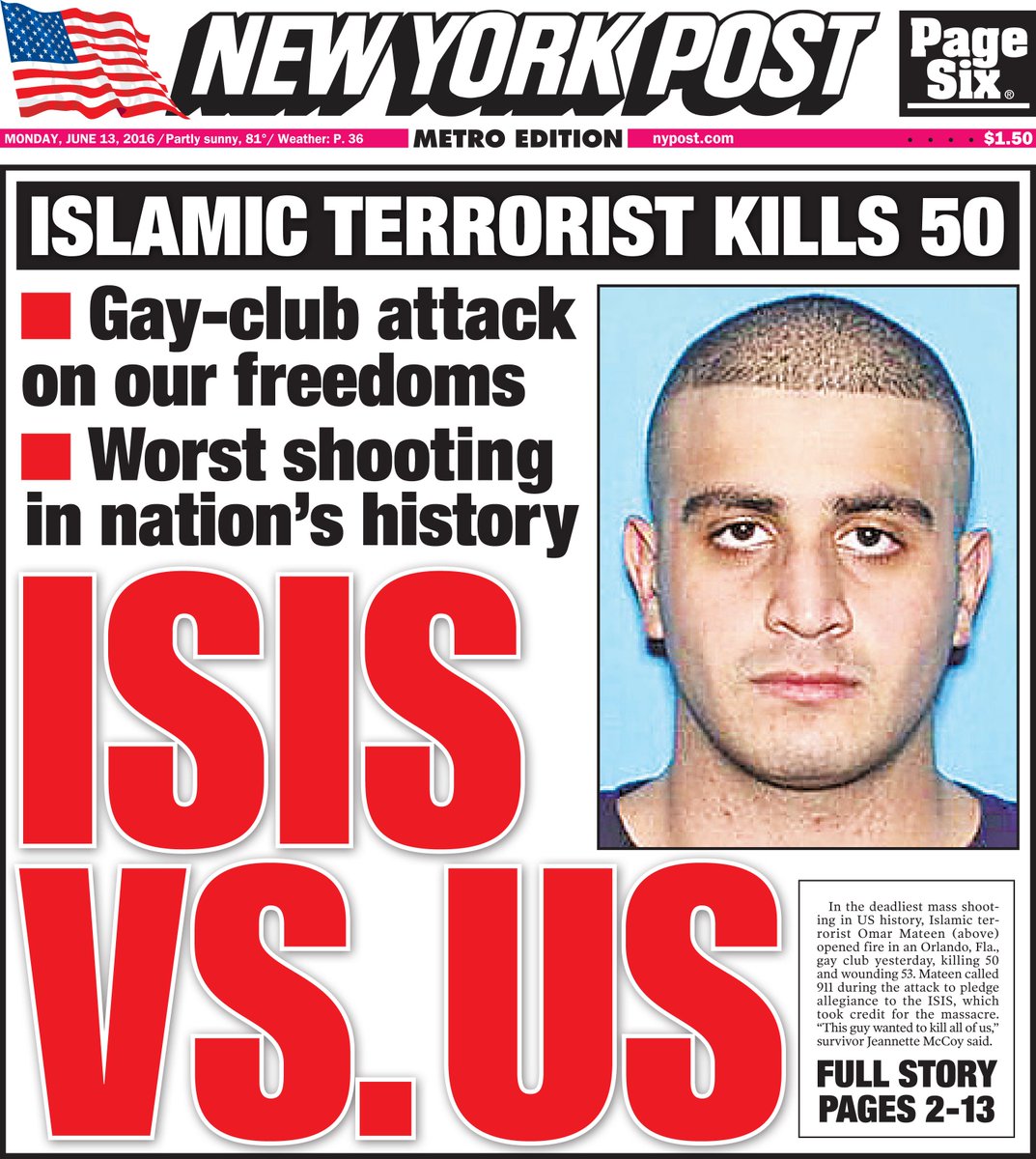
Omar Mateen, an Afghan-American born in NYC, killed 49 at a "popular" gay nightclub (I love that modifier in the media) in Orlando until he was killed by police commandos.

Was he a "homegrown" terrrorist?  Apparently the FBI talked to him, twice.  Or so they say.  Never enough to bring him him.   No internet profile must have tipped them.

Was he nuts?  Ex-wife and co-workers said he was crazy.  Now you tell us!  Lady, how about reporting his beating you to the police?  Might have helped.

Affiliated with ISIS?  Well, he pledged allegiance to ISIS on 911 and he went on a haj twice to Saudi Arabia.   Yup, this was an ISIS attack alright!

Did he hate gays?  FBI chief James Comey said they also are looking into "homophobia" as a possible motive.  Your tax dollars at work.

Was he gay?  (Oh, don't go there.  But lots of questions unanswered, like, how did he get in with a AR-15?   Wouldn't that be somewhat conspicuous?  Did he kill the bouncers?  Did the club have any security at all?)

Hearing a lot of "explanations" for this mass murder.   And that it is an attack on our "freedoms." (See below.)  Okay.  But we have all these competing freedoms!   We want to be free to have open borders, and gay nightclubs, and guns-guns-guns, and radical mosques, and crazy people on the loose and off their meds.  We shouldn't be too surprised if, sometimes, these very different freedoms start rubbing into one another in a nonconstructive sort of way.


Monday, June 6, 2016

Muhammad Ali: Not a Leader, but a Warrior

When I think of Muhammad Ali, I think of a great fighter who fought the best of his era, and won most of the time.  Unusual for a heavyweight of his caliber, he lacked a knockout punch, but he had great quickness, endurance, defensive ability, and resilience.  No one took a punch better than Ali.

He was the best heavyweight boxer in an era with tremendous competition.  We have not seen the same level of competition since.

Ali was a big heavyweight for his time.  At 6' 3" and usually around 220 lbs, he often loomed over his competition.  Consider that in the 1950s, heavyweight champs were usually in the 200 lb range.  By the 1960s, it was getting harder to compete at that size.

Certainly he was one of the most charismatic athletes ever, and his fights were truly "main events."  The lead-up to Ali's first fight against Joe Frazier dominated the cover of Time magazine.

Here's a great column by Mushnick that debunks some of the popular Ali myths:  debunking-the-myths-that-have-glorified-muhammad-ali

A lot of Ali's appeal with liberals was his civil disobedience against the draft, which cost him three prime career years.   The great paradox is that he did this for the sake of black separatism, and of course the great liberal issue of the time (as it should have been) was black integration.  Liberals apparently can't decide which they like better.

If Ali had had better handlers, the draft never would have been an issue for his career, as there were plenty of ways to get a deferment.  But he had joined the Nation of Islam, a racist cult, and its leadership urged this political statement.  Ali's mentor was Elijah Muhammad, who most experts believe ordered the assassination of Malcolm X.  Ali joined this after white America passed the Civil Rights Act and the Voting Rights Act.

A big point is being made in the obits on how Ali taunted Ernie Terrell because Terrell still called him "Cassius Clay," his so-called "slave name."  But if you know anything about the era, many of his opponents wouldn't call him Muhammad Ali for a long time, including Joe Frazier.  Probably because they thought his conversion was just a pose.

Ali was a terrible sportsman, which was unusual for boxing at the time.  He not only mocked Terrell, but Floyd Paterson, and Joe Frazier (whom he called an Uncle Tom) and George Foreman, whom he likened to the "Belgians" before he fought him in Zaire.  How he turned fighting other black men into a racial thing still is perplexing, but this highlights his masterful self-promotion.

A few of Ali's fights were suspicious.  I still suspect he threw the first fight against Leon Spinks, a guy who shouldn't have been in the same ring with him, just so he could come back and beat him and be a third-time champion.   Many observers at the time thought Jimmy Young beat Ali, but Ali got the decision.

I'm not sure exactly what Ali "transcended," as some of the overwrought writers are claiming.  They seem to equate self-promotion with profundity.  Not sure what cause he was fighting for.  Other fighters mocked the idea he was fighting for black people.  Like the rest of them, he was a warrior, fighting for himself.

One Punch: How Ken Norton Became a Boxing Legend in a Single Night
In 1973 the little-regarded Ken Norton beat Ali and broke his jaw.

Wednesday, June 1, 2016

No Medical Marijuana for Stressed Vets!

Here's a great piece from the Weekly Standard by a doc who used to work in the office of the drug czar at the WH.  Pot for Stressed Vets  Apparently a bill is circulating through Congress to allow the Veterans Administration to start prescribing pot for veterans with post-traumatic stress disorder.

This hits home, literally, because last Sunday an Afghanistan veteran, supposedly suffering from PTSD, shot up a suburban neighborhood, killing one, wounding several, and destroying several cars and a gas station.  He was clearly nuts.   But PTSD?   We don't know how he was discharged yet; maybe a medical.  Wanna bet he was no stranger to the demon weed?

Wednesday, May 25, 2016

Mexican Champion of Democracy Passes Away

Luis H. Alvarez, R.I.P.  I interviewed him years ago when preparing my dissertation (which became the book "An Eternal Struggle."  A son of Texas, too; he grew up in El Paso, he told me.


By PAULINA VILLEGAS
NYT, MAY 24, 2016
MEXICO CITY — Luis H. Álvarez, a leading figure in the conservative National Action Party in Mexico who dedicated his life to the fight for democracy there, died on May 18 at his home in León, Mexico. He was 96.
The cause was complications of pneumonia, his nephew Fernando Álvarez said.
Mr. Álvarez, who was originally a textile executive, was steadfast in his efforts to end the long rule of Mexico’s Institutional Revolutionary Party, known as the PRI.
In 1958, he ran unsuccessfully for president against that party’s candidate, Adolfo López Mateos, in what seemed like a quixotic campaign.
Almost three decades later, with the ruling party still immovable, he rallied opposition in Chihuahua, his home state, to protest voting fraud, undertaking a long hunger strike that helped focus international attention on the Mexican opposition’s struggle for democracy.
But it was not until 2000, when the National Action Party, or PAN, won the presidency, that the PRI’s 71-year rule ended.
In a statement after Mr. Álvarez’s death, the National Action Party’s leader, Ricardo Anaya, called him “one of the greatest figures in our recent history.”
At the pinnacle of the PRI’s grip on power, Mr. Álvarez ran for governor of Chihuahua in 1956 and lost. He had not been an active party member before that, but was widely known for his community involvement and civil rights work.
Two years later, while running for president, Mr. Álvarez was arrested and briefly jailed — because, he said, he was told that being an opposition presidential candidate was illegal.
Mr. Álvarez denounced the ruling party’s tactics — which included personal threats during political rallies and raids on polling stations — and a political structure that he said made it impossible to hold fair elections.
In 1956, he led a “caravan for democracy” from Chihuahua, in the north of Mexico, to Mexico City to deliver to the attorney general’s office evidence of electoral fraud in state elections.
Mr. Álvarez was mayor of Chihuahua, the state capital, when he went on a hunger strike in 1986 to call attention to accusations of vote-rigging in local elections.
Lasting 41 days, the hunger strike brought him prominence in the party’s ranks and on the national political scene. He lost 15 pounds and was hospitalized afterward.
The next year, at 67, he was named party leader, a position he held through 1993. During his tenure, the National Action Party won its first state elections, first in Baja California and then in Chihuahua.
Mr. Álvarez was criticized for negotiating with President Carlos Salinas de Gortari, whose election in 1988 was tainted by allegations of fraud but who adopted many of the market-oriented reforms that the National Action Party had long promoted.
His willingness to compromise helped to pave the way for the party’s acceptance as a legitimate political force, and for its eventual success in claiming the presidency.
“He showed us all what to do and how to be, in order to make this country a better place,” Cecilia Romero, a congresswoman who worked closely with Mr. Álvarez when he was head of the party, said in an interview.
Friends and family recalled Mr. Álvarez as a jovial yet feisty character, prone to long political discussions over dinner.
Luis Héctor Álvarez was born on Oct. 25, 1919, in Chihuahua and earned a degree in business administration from the University of Texas, Austin.
He worked in agriculture for a few years before entering the textile business. He was also a member of a civil rights association in Ciudad Juárez.
Mr. Álvarez’s wife, Blanca Magrassi, also a prominent party member, died last year. He is survived by a son, Luis Jorge; a daughter, Blanca Estela; five grandchildren; and four great-grandchildren.
In 2000, the National Action Party candidate, Vicente Fox, was elected president, removing the PRI from power and signaling the end of a regime that had influenced nearly all aspects of Mexican life in the 20th century.
Soon after taking office, Mr. Fox named Mr. Álvarez peace negotiator for talks with the leftist rebels of the Zapatista revolutionary movement in the southern state of Chiapas.
Mr. Álvarez was later a senator for his home state. He was appointed commissioner for indigenous affairs by President Felipe Calderón in 2006.
His nephew Fernando remembered the moment Mr. Álvarez got the call announcing the results of the 2000 presidential election: “His small eyes went wide open as he grabbed my arm and asked, ‘Is this really possible?’ ”

His uncle, Fernando recalled, then said: “I have accomplished my mission. I can now die in peace.”
Friday, May 20, 2016

Six Months Ago in Paris--What Really Happened

This is the most vivid account I've seen of the Bataclan shootings that killed 89 at the metal concert. Concert goers executed like sheep, the shooting went on forever.  Surrendering to Death

One armed French cop did a lot of damage to the terrorists.  Imagine if the police response had been better?  The lead singer argues that security at the concert site was amazingly lax that night.   This piece says hundreds of mosques were searched after the attack, with lots of recruitment material found.

Monday, May 16, 2016

Hillary Must Be Stopped

Fred Barnes breaks from the pack at the Weekly Standard by essentially backing a vote for Trump. Why?  Because Hillary is a total leftist.  She has no redeeming virtues.  Whatever good ideas she had in the past she's now abandoned.  Conservatives will lose a lot if she wins.  The country will lose a lot if she wins.  Read this piece "The Hillary Myth" by Barnes and see if you agree:  http://www.weeklystandard.com/the-hillary-myth/article/2002380

The bottom line in choosing Trump might be this: not as bad as the other option, with the possibility of something good.   Actually, that is the only reason to vote Republican anyway.

Many neocons have been urging a vote for Hillary.  This is unsurprising.  They are liberals on domestic policy and support an interventionist foreign policy. Trump is their antithesis.  Hillary is not totally to their liking, but she at least offers the opportunity of a stupid war somewhere.

Tuesday, May 3, 2016

The Son of Anarchy Strikes Again!

Robert Kaplan, the world traveler and international political pundit, just wrote "The Post-Imperial Moment" in the National Interest, which I commend to you as a perfect example of his writing.  The man has never seen a molehill that he didn't call a mountain.  Years after his "The Coming Anarchy" was published in Atlantic (I think in 1994!), he continues to flog this dog-eared idea.  A few rebuttal points:

  • No, the world isn't descending into "vulgar, populist anarchy."  What does that even mean?
  • Countries are not fighting over territory.  Interstate wars are nearly nonexistent.
  • In fact, there is more interstate cooperation than ever.  Sure, nationalism is still strong, but that doesn't mean states are cooperating less.
  • The EU is managing its crisis and is not breaking up.
  • Why does he think Africa is disintegrating?  And ISIS-related groups are hardly "rampaging" through west Africa.  They are on the eclipse.
  • What is new about international terrorism?   Why does Kaplan think an airport attack is, a new thing in the world?
  • How is it that the US is withdrawing from the world?  We have 600 international military bases and are now deployed--again--in Iraq.  
  • What is the big deal about Indian and Chinese naval ships in the Indian Ocean?  Are they going to start duking it out?   Over what?  
You could go on and on.  He never really defines anything or cites any facts to back up his points. He's like a Single-A Spengler.   

And why does he think anyone wants to read a book about Romania?  Are we that enamored of the Kaplan pensées that we'll buy anything by him?  His publisher probably is kicking herself right now...